Archive for November 2022
XGBoost tree boosting for machine learning
When reading the AutoML benchmark I saw that XGBoost was one of the more recommended models: I decided to learn about it and I read this paper:
XGBoost: A Scalable Tree Boosting System. Tianqi Chen, Carlos Guestrin, KDD ’16, August 13-17, 2016, San Francisco, CA, USA https://dl.acm.org/doi/10.1145/2939672.2939785
The article dates 2016, and reports that at that time this algorithm has been successfully used in many competitions obtaining the best placements. Among the 29 challenge winning solutions published at Kaggle’s blog during 2015, 17 solutions used XGBoost. Among these solutions, eight solely used XGBoost to train the model, while most others combined XGBoost with neural nets. A similar situation is reported for the KDD cup in 2015. This algorithm scales up to billion of training samples, and is open source and available on https://github.com/dmlc/xgboost and currently active.
The algorithm consists in finding a tree set: in each tree an internal node consists in a condition on the inputs features, and the leafs consists of real numbers. With a new set of inputs, each tree is evaluated and provides one weight, all the weight are summed to give a final results, that is the classification/prediction searched. Given this structure is easy to understand that it is very easy to parallelize the evaluation, obtaining good performances.
The paper describes many optimization done to make the algorithm fast. It is quite common for input data to be sparse, for instance because one-hot encoding has been used, or because many values are absent. This has been take into account, and the authors reports that the sparsity-aware algorithm runs 50 time faster that the basic version. The input data are prepared, sorting them in ascending order, and dividing inputs in blocks. Choosing the right block size allows to avoid cache misses in data access, and also allows to run the analysis on multiple cores/servers. Prepared data can also be reused many times, avoiding to pay again and again the preparation cost. The data blocks can be compressed and the work divided into reading threads and processing threads: the reading threads read an decompress the blocks, while the processing threads process them. The authors suggest also to shard the input data on multiple disks, to parallelize the access and improve performances. For instance the authors report:
We can find that compression helps to speed up computation by factor of three, and sharding into two disks further gives 2x speedup. For this type of experiment, it is important to use a very large dataset to drain the system file cache for a real out-of-core setting… Our final method is able to process 1.7 billion examples on a single machine
All these details testify the amount of work and interest for this library.
But how this library builds a model from the input data? Let’s first of all introduce some names
n is the number of input samples
m is the number of input features (dimensions)
Each input sample is composed of <x1, x2, … x_m, y> where y is the value to be predicted
i is the index in the n samples
K is the number of trees used to predict y
T is the number of leaves in a tree
w is the weight attached to a leaf
t is the learning iteration
The function that is optimized by this algorithm is

So the difference between the actual and predicted value plus a normalization factor that penalizes the number of nodes used in the trees T and the square of the weights used in the models. This normalization has been added to penalize complex models with high values, and is effective on preventing overfitting.
The algorithm iteratively adds one new tree at each step, choosing the tree that reduces the most the loss function L.

Above you see an approximation that is used in the algorithm: g_i and h_i are the first and second order derivative, and f_t is the tree function that we are looking for at iteration t. Really I do not understand how you can get these derivative, I will have to read the bibliography to understand how it is possible to calculate these values.
After some steps the authors present how to calculate the optimal value for a new tree leaf, and how much a proposed tree will reduce L


Here I_j is the set of input that is selected by the jth leaf in the proposed tree. The algorithm iteratively builds a new tree adding more and more splits, calculates the improvement of each tree and at the end chooses the best tree. To decide the splits the authors introduced a quantile based approach, so the splits are done evenly over data distribution.
The sparse data optimization consists in choosing a default direction in the trees: each time an input is missing you follow that direction. The good direction is decided tree by tree, of course the one that minimizes L
In the end the good tree is chosen enumerating possibilities, and using multiplications and sums: so you can create a good model using a very large set of trees instead of stacking layers and layers of neurons.
Katib
I think I have explored enough the hyper-parameters tuning tools: to conclude this series I had a look at Katib because it fits well the environment I can use at work. This time I did not have fun looking at strange algorithms, as Katib is just a shell that allows you to run comfortably optimization tools in Kubernetes. By chance I saw in Google that Katib, or better Kātib, was a writer, scribe, or secretary in the Arabic-speaking world (Wikipedia): indeed the tool keep tracks of optimization results, schedules new executions and provide an UI, a good secretary job.
This paper describes Katib:
A Scalable and Cloud-Native Hyperparameter Tuning System. Johnu George, Ce Gao, Richard Liu, Hou Gang Liu, Yuan Tang, Ramdoot Pydipaty, Amit Kumar Saha. arXiv:2006.02085v2 [cs.DC] 8 Jun 2020
link: https://arxiv.org/abs/2006.02085
The authors are from Cisco, Google, IBM, Caicloud, and Ant Financial Services.
Katib is part of Kubeflow, a Kubernetes platform to industrialize working on machine learning. Katib does not offer you a specific algorithm to optimize parameters, it is instead a shell allowing you to run in a reliable way other tools. From the article introduction you get that: you must be familiar with Kubernetes, you can run it on your laptop but in the end is done to run on a Kubernetes cluster, it is open source, and it is thought also for operation guys.
As it is built on top of Kubernetes, you can have one cluster with many namespaces into it, and segregate each team work into a different namespace. You can leverage Kube role management, to configure the permissions to access these namespaces. Katib provides logging an monitoring to get insight in what it is going on during the simulations.
As many other Kube tools, you configure your experiments with yaml resources. These resources are fetched from some controllers that update theirs states and tries to fulfill what you are asking for. this is the example reported in the paper:

The parallelTrialCount allow to specify how many processes to run in parallel, to limit the resources used by a team. As you can imagine, scalability is not an issues as all works the cloud way. The authors say they used chaos-engineering tools to stress Katib and verify that it is robust enough to be user in real applications.
This is a reporting view on trial results:
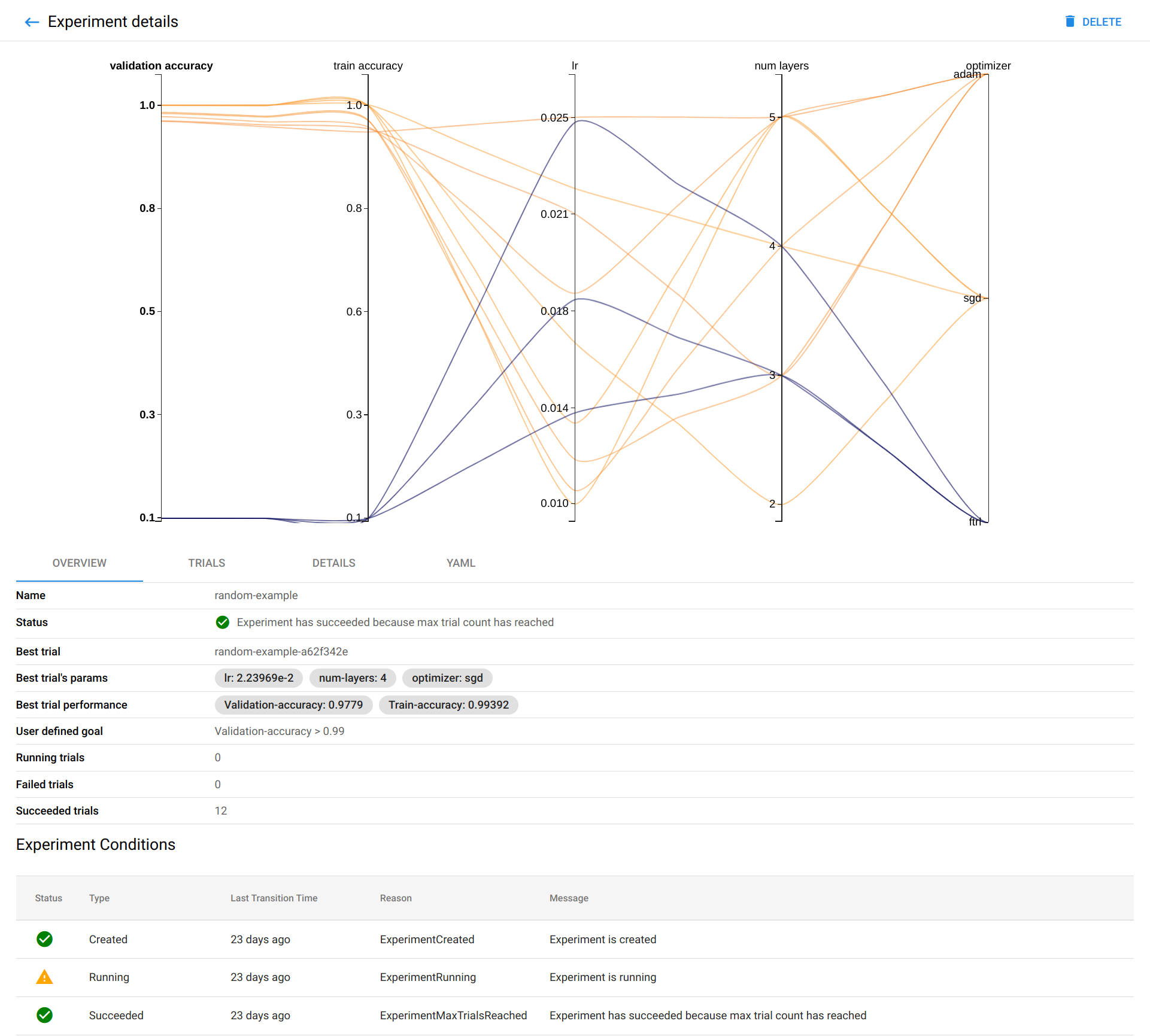
The leftmost axis, called validation accuracy, is the target function to optimize – here the higher the better. Following the orange lines on the other axis you can see which have been the hyper-parameters values that have given the better results. For instance here seems it is better to have the learning rate between 0.01 and 0.018.
And that’s all I had to say.
The ugly solar panel odyssey
Some time has passed since I wrote about climate change: I have been busy, but progressed on my solar panels project. You will see that this requires a lot of time here in France.

In April this year, I started asking myself if I could put solar panels on my roof and what benefits I can expect. I could just switch to a contract that guarantees green electricity, but I liked the idea of being part of the energy transition. I like also the idea of being more independent from electric companies: now that there is a war in Ukraine, and all the energy prices explose, I feel right.
But what should you do to have solar panels on your roof? It is not an easy task where you choose a module, and you install it yourself. You need the right stuff to fix them, the right cables, the inverter, fill many administrative papers… too many things to know. So I asked for a quote to three different big companies. As I am a stranger here in France and I don’t have many contacts, I preferred to avoid asking quotes to small shops.
I got a wide range of prices: 8000 euros, 10000 euros and 13000 euros for the same installation of 3 kw peak power. I checked the reputation of the cheapest provider: the customers comments weren’t that good. 5000 euros difference seems to me a bit too much anyway.
The guy of the 10000 offer was really professional and provided me many details on the equipment and the laws. Unfortunately you cannot just choose a provider and do the installation.
I live in a co-property: I own one house, but it is inside a big complex. I need to ask a permission to the administrator to make any changes to the house exterior. When I asked the administrator, they replied that I had to present a project and have it voted to the owners assembly. I asked this in April, and the assembly has been just held this November 17! Seven months delay!
Here in France you have the right to install a plug in the co-property if you need to recharge an electric car, just presenting some documentation. The same for a TV antenna, but if you want to produce your own energy you can’t.
Many speaks of energy transition, climate change, but when you want to act, you realize that it is all so complicated.
Also the incentives the country provide are not that good. For a 3kw installation you will get 1000 euro only, payed in 5 years! If you buy an electric car you get 6000 euro now! Your VAT is reduced to 10% but only if your installation is not above 3kw. If you want to produce more, you pay 20% VAT. Isn’t this a mistake? The more solar energy, the more autonomy from foreign countries.
Also you can sell 1 kw of solar energy to the electric grid, but you will get 0.10 euros. If you look at your bill, you will see the price is about 0.16… and this was before the war beginning.
So a lot of time passed, but I will tell what happened in the owner assembly next time – and then you will understand why I have put the word “ugly” in the title
Optuna: efficiently tune your model
I wanted to find a tool implementing the TPE algorithm to explore the model hyper-parameter spaces, and after searching a bit I have found the original implementation, but there was no recent activity on it. After some other tries I have found Optuna and the article that introduces it:
Takuya Akiba, Shotaro Sano, Toshihiko Yanase, Takeru Ohta, Masanori
Koyama. 2019. Optuna: A Next-generation Hyperparameter Optimization
Framework. In The 25th ACM SIGKDD Conference on Knowledge Discovery
and Data Mining (KDD ’19), August 4–8, 2019, Anchorage, AK, USA. ACM,
New York, NY, USA, 9 pages. https://doi.org/10.1145/3292500.3330701
The article is quite recent and provides references to other similar tools that can be useful: Spearmint and GPyOpt which use Gaussian Processes, Hyperopt employs tree-structured Parzen estimator (TPE), SMAC uses random forests, Google Vizier Katib
and Tune also support pruning algorithms, Ray Tune.
What makes Optuna special? It’s approach in defining the hyper-parameters space to explore. The example provided by the authors is very clear: they propose to tune a neural network that can have up to 4 layer, and where each layer can have up to 128 units. What is the difficulty here? You will always have a number of neurons for layer 1, but you will have a number of neurons for layer 3 only if layer 2 and layer 3 exists. For instance with Hyperopt you need to use choice constructs to describe this conditional relation and the code is not so easy to read. With Optuna instead you have this approach, called define-by-run:

Using Optuna you define a study (line 20) and you want to optimize it in 100 trials (line 21). The objective function defines which hyper-parameters are pertinent and the loss function. The trial here is the current test instance, at line 5 it is said that the model has up to 4 layers: actually at that point when executing the code Optuna will use the past experiments to decide which is the best candidate value to use. Then, with a simple for loop it is asked to Optuna to get the most promising number of neurons for each layer. It is easy to do so because you do not need to deal with condition, at that point in the code you know that you have x layers and you can just define the parameters needed. The rest of the code is to use the parameters, read the train and test data and compute the model performance.
With Hyperopt instead you have to do something like this:

You can find the complete examples in the paper. It is easy to understand that, with more and more options to explore, a model made with Optuna will be easier to understand and modify.
Optuna has also something more to offer: an efficient pruning algorithm: unpromising trials are abandoned before a complete train/test cycle, freeing resources to explore other configurations. The pruning algorithm used is named Asynchronous Successive Halving(ASHA) and is an extension of Successive Halving. To understand how it works it is better to read the article describing successive halving:
Kevin Jamieson, Ameet Talwalkar. Non-stochastic Best Arm Identification and Hyperparameter Optimization. Proceedings of the 19th International Conference on Artificial Intelligence and Statistics (AISTATS) 2016, Cadiz, Spain.
Here Arm refers to a specific hyper-parameter instance. Intermediate loss functions values are compared between different arms, only half of the arms will survive each time selecting the best ones. In this setting, the question is not if the algorithm will identify the best arm, but how fast it does so relative to a baseline method, as no specific statistic assumptions are made. The plots published in the paper are really encouraging.
Coming back to Optuna, you can choose the algorithm used to select the next candidates parameters: you have TPE and also a mix of TPE and CMA-CS. According to the authors, GPyOpt can obtain better results but it is one order of magnitude slower than Optuna.
Other Optuna advantages are that you can choose the backend used to store the trials performances (for instance use a database), and that it is easy to install it and use it in conjunction with Jupyter and Pandas.
To conclude, you can use Optuna also for tasks not related to neural networks and machine learning: the authors reports that it has bee used to find optimal parameters for RocksDB (which has many many parameters to tune) and ffmpeg configurations for video encoding
AutoML tools – get help on choosing models and parameters
While searching for tools implementing the techniques I have recently read (variance analysis and optimized hyper-parameter search) I have found this interesting paper:
L. Ferreira, A. Pilastri, C. M. Martins, P. M. Pires and P. Cortez, “A Comparison of AutoML Tools for Machine Learning, Deep Learning and XGBoost,” 2021 International Joint Conference on Neural Networks (IJCNN), 2021, pp. 1-8, doi: 10.1109/IJCNN52387.2021.9534091.
pdf download
The authors have listed a long set of tools and conducted may experiments to compare recent AutoML solutions. But what is AutoML? The idea is that it is possible to build tools that allow non-experts to make use of machine learning models and techniques without requiring them to become experts in machine learning. Wikipedia
In the paper they compared these tools: Auto-Keras, Auto-PyTorch, Auto-Sklearn, AutoGluon, H2O AutoML, rminer, TPOT and TransmogrifAI. To compare them, they used 12 different OpenML datasets divided in 3 different scenarios General Machine Learning (GML), Deep Learning (DL) and XGBoost(XGB). So 8 tool by 12 models, 96 combinations, for sure there is a big effort behind this study. In the paper you find also a lot of references to other studies and tool descriptions, precious if you want to explore further.
The datasets used to compare the tools are the most downloaded ones from OpenML, and the tools have been used with theirs default parameters, as newbie user would do. The results reported privileges in first place the obtained model performance, and in second place the time spent performing the analysis.
For what concerns general machine learning, the data sets have been divided in binary classification, multi-class and regression tasks. There is not a tool that wins the other in all categories: TransmogrifAI is the best for binary classification, but H2O is very very close. In multi-class categorization AutoGluon is the best but again H2O is very close. Finally for regression there is no much difference between the results. For deep learning models, again H2O is one of the best tool. AutoGluon again wins in one sub-category. In XGB scenarios the the best tools are rminer and H2O.
There is one more interesting point: the models created by these tools have performances close to the best reported in on OpenML, so these tools are definitively something to try.
Given the results I had quickly a look to H2O site, as it appears so often in the top scores. The sample linked here is quite easy to understand.
import h2o
from h2o.automl import H2OAutoML

# Start the H2O cluster (locally)
h2o.init()

# Import a sample binary outcome train/test set into H2O
train = h2o.import_file("https://s3.amazonaws.com/erin-data/higgs/higgs_train_10k.csv")
test = h2o.import_file("https://s3.amazonaws.com/erin-data/higgs/higgs_test_5k.csv")

# Identify predictors and response
x = train.columns
y = "response"
x.remove(y)

# For binary classification, response should be a factor
train[y] = train[y].asfactor()
test[y] = test[y].asfactor()

# Run AutoML for 20 base models
aml = H2OAutoML(max_models=20, seed=1)
aml.train(x=x, y=y, training_frame=train)

# View the AutoML Leaderboard
lb = aml.leaderboard
lb.head(rows=lb.nrows)  # Print all rows instead of default (10 rows)

# model_id                                                  auc    logloss    mean_per_class_error      rmse       mse
# ---------------------------------------------------  --------  ---------  ----------------------  --------  --------
# StackedEnsemble_AllModels_AutoML_20181212_105540     0.789801   0.551109                0.333174  0.43211   0.186719
# StackedEnsemble_BestOfFamily_AutoML_20181212_105540  0.788425   0.552145                0.323192  0.432625  0.187165
# XGBoost_1_AutoML_20181212_105540                     0.784651   0.55753                 0.325471  0.434949  0.189181
...
I have copied the example from this page: https://docs.h2o.ai/h2o/latest-stable/h2o-docs/automl.html#code-examples. So with few lines of code you can define how many model to test and obtain indications on which one to pick. This page is quite long and provides many information; for instance you see wich models H2O is able to investigate: three pre-specified XGBoost GBM (Gradient Boosting Machine) models, a fixed grid of GLMs, a default Random Forest (DRF), five pre-specified H2O GBMs, a near-default Deep Neural Net, an Extremely Randomized Forest (XRT), a random grid of XGBoost GBMs, a random grid of H2O GBMs, and a random grid of Deep Neural Nets. You see also the list of hyper-parameters that will be searched with grid search.
 Giovanni Bricconi